By Dave Workman
Adam Kraut, executive director of the Second Amendment Foundation, has authored an Op-Ed at Fox News as the U.S. Supreme Court oral arguments challenging bans on modern semiautomatic firearms looms next Wednesday, Dec. 2.
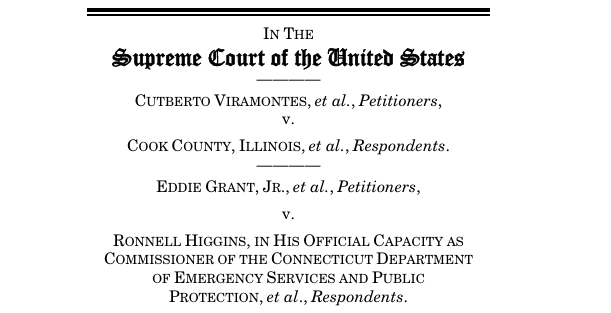
The consolidated cases of Viramontes v. Cook County (Illinois) and Grant v. Higgins (Connecticut), are both SAF cases. They provide an opportunity for the Court to weigh in on both a local jurisdictional ban on so-called “assault weapons,” and on a statewide prohibition.
“These laws are unconstitutional and unfairly target law-abiding Americans,” Kraut writes. “The Second Amendment Foundation has been in this fight since 2019, having filed 9 cases challenging these exact types of laws across the nation. As a plaintiff in both cases before the Supreme Court, SAF has stuck with these cases while lower courts rubber-stamped both bans. And despite years of slow and expensive litigation, the nation’s highest court will finally hear argument.”
At issue is not just whether a state legislature or local government can ban possession of AR-15 and similar firearms, but whether—as Kraut points out—the Second Amendment “truly protects our right to bear arms.”
Kraut, along with SAF founder and Executive Vice President Alan Gottlieb, will be in the Supreme Court chambers during the oral arguments. Also present will be Holly Sullivan Cicale, head of the Connecticut Citizens Defense League, which is a plaintiff in the case. Her presence also brings the Citizens Committee for the Right to Keep and Bear Arms directly and indirectly, as CCDL is a state affiliate of the grassroots Committee, and she also sits on the CCRKBA board of directors.
CCRKBA and SAF are sister organizations.
In his 730-word Op-Ed. Kraut fully describes the importance of these consolidated cases.
“The stakes of our cases extend well beyond the places where they originated,” he writes. “If the bans stand, no gun owner in America is safe. Eleven states, the District of Columbia, and countless local governments have already passed copycat laws. And more will surely follow if the Court lets them.”
Kraut also notes, “Simply put, if states can ban the most common rifle in America, then the Second Amendment’s guarantee means very little in practice. And there is simply no historical tradition to support this sort of sweeping ban; in the 19th century we moved from single-shot flintlock muskets to repeating arms like the Colt revolver and later the Winchester repeating rifles that famously ‘won the West.’ This massive jump in firepower was not met with any state bans, nor later was the move to semiautomatic platforms.”
How the oral arguments go will provide a strong indication about how the Court will rule, with a decision not expected until sometime in late June 2027.